
In today’s era of ubiquitous mobile offices and smart devices, screen privacy has evolved from a “nice-to-have” feature into a necessity for business professionals, public officials, and everyday consumers. From smartphones and laptops to financial terminals, privacy technology is used across a wide variety of scenarios.
However, consumers often encounter issues when choosing privacy products: some films render the screen dim and color-distorted; others produce visible “rainbow patterns” or Moiré patterns when viewed at an angle; and some suffer from delamination or peeling after short-term use. These poor user experiences stem directly from the primary technical barrier in privacy film manufacturing: the R&D and mass production of the Micro Louver optical structure.
This article breaks down the technical essence of the Micro Louver optical structure in accessible terms, revealing the real-world challenges a modern privacy film factory faces in overcoming these manufacturing hurdles.

What Is Micro Louver? How the Optical “Venetian Blind” Works
To understand privacy film technical barriers, one must first understand their core optical physics mechanism.
In simple terms, Micro Louver technology integrates thousands of micro-scale gratings arranged in parallel at micro-meter intervals inside a thin film. This optical structure operates across two key dimensions:
Clear Frontal View: When viewed directly from the front (typically $0^\circ$ to $30^\circ$), light passes unhindered through the micro-louvers, delivering a clear, color-accurate image.
Side View Obscuration: When someone attempts to peek from the side (typically at angles greater than $20^\circ$ or $30^\circ$), side-emitted light is intercepted by internal black light-absorbing layers, making the side view appear completely dark.
While the concept is straightforward, embedding micro-scale “venetian blinds” inside a thin film only a few hundred micrometers thick presents immense challenges in material science and industrial engineering.

R&D and Mass Production Challenges: Three Major Hurdles from Lab to Factory
Creating a high-performance privacy film requires far more than simply “etching a fence.” In both R&D and high-volume manufacturing, a privacy film factory must overcome three technical barriers:
1. Structure Miniaturization & High-Aspect-Ratio Mold Fabrication
To deliver precise privacy protection without sacrificing screen resolution, Micro Louver grating spacing must be kept within tens of micrometers, requiring a high height-to-width (aspect) ratio.
R&D Challenge: Micro-structure mold etching requires nanometer-level precision. Uneven slot depths or microscopic burrs cause abnormal light refraction, resulting in glare or severe rainbow patterns.
Mass Production Challenge: On high-speed roll-to-roll production lines, micro-structures deform easily under pressure. Maintaining absolute consistency across tens of thousands of meters of film during high-speed embossing is a key indicator of a factory’s engineering capability.
2. Precise Light-Absorbing Fill & Fluid Control
Once the micro-slots are formed, efficient black light-absorbing resin must be evenly filled into these tiny grooves.
R&D Challenge: The light-absorbing material must offer high opacity to block off-axis light while leaving zero residue in the central light pass-through channels, which would otherwise dim the screen.
Mass Production Challenge: The filling process is prone to bubbles or uneven coating. A microscopic gap as small as a thousandth of a millimeter can cause “light leaks” at specific angles, rendering the entire roll defective.
3. Multi-Layer Lamination & Moiré Interference Elimination
Modern privacy films are multi-layer composites, featuring anti-blue light layers, anti-fingerprint coatings, anti-glare (AG) surfaces, and highly transparent PET substrates.
R&D Challenge: Overlapping screen pixels (RGB sub-pixels) with the Micro Louver structure can create visible interference patterns known as Moiré patterns. R&D teams must use precise angle-offset algorithms to reduce Moiré patterns below human perception.
Mass Production Challenge: Lamination of multiple optical layers is sensitive to ambient temperature and humidity. Minor tension imbalances during continuous processing cause film curling, delamination, or refractive index mismatches.

Shenzhen Yizhen Technology: Setting New Industry Standards with Advanced Manufacturing
Facing the R&D and mass production challenges of Micro Louver optical structures, conventional manufacturers often produce dim, yellowing, or high-glare products due to limited technical capability and precision equipment. In contrast, Shenzhen Yizhen Technology Co., Ltd., a global manufacturer of screen protector solutions, has overcome these technical barriers through deep expertise in micro-nano fabrication and optical film processing, providing top-tier privacy protection experiences worldwide.
1. 20^\circ Ultra-Narrow Privacy with High Light Transmittance
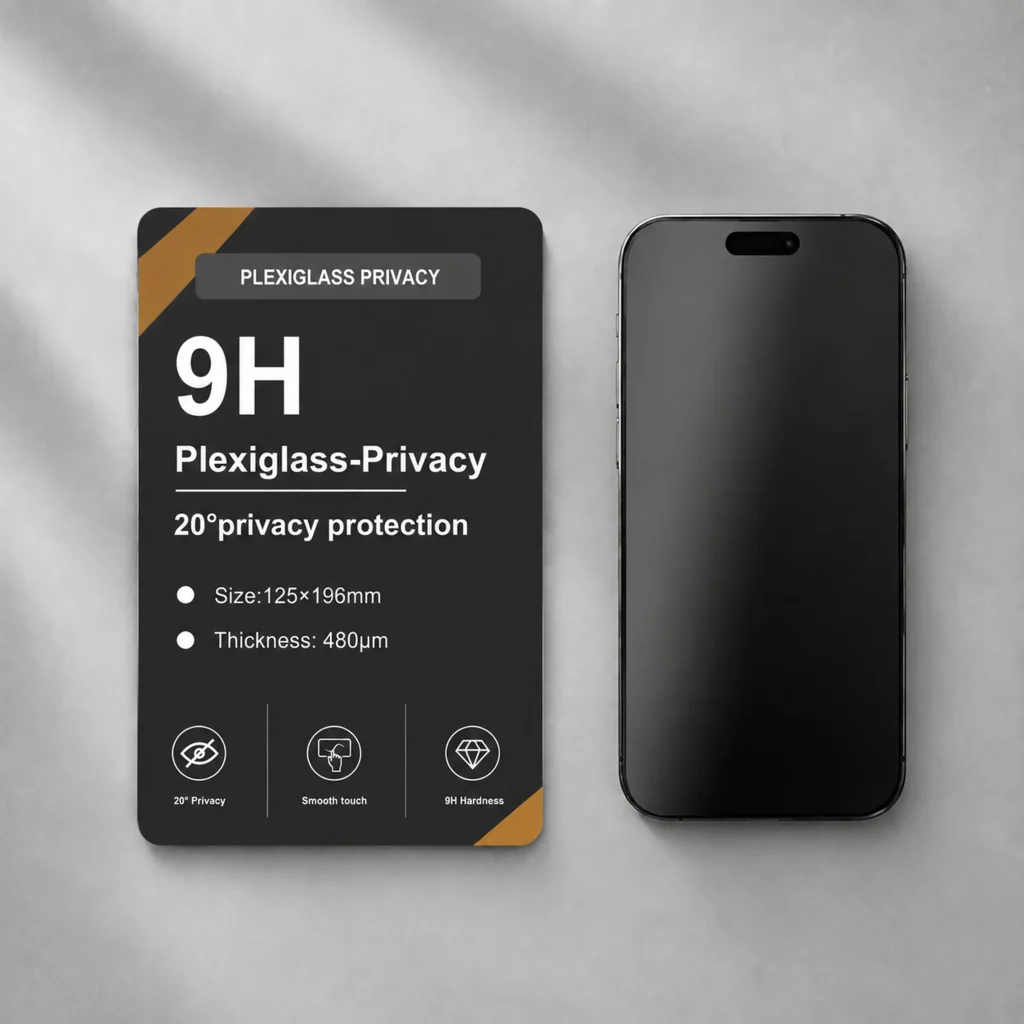
Yizhen has introduced flagship 9H Plexiglass Privacy and Alwaysclear Privacy film series using high-precision micro-louver optical structure designs.
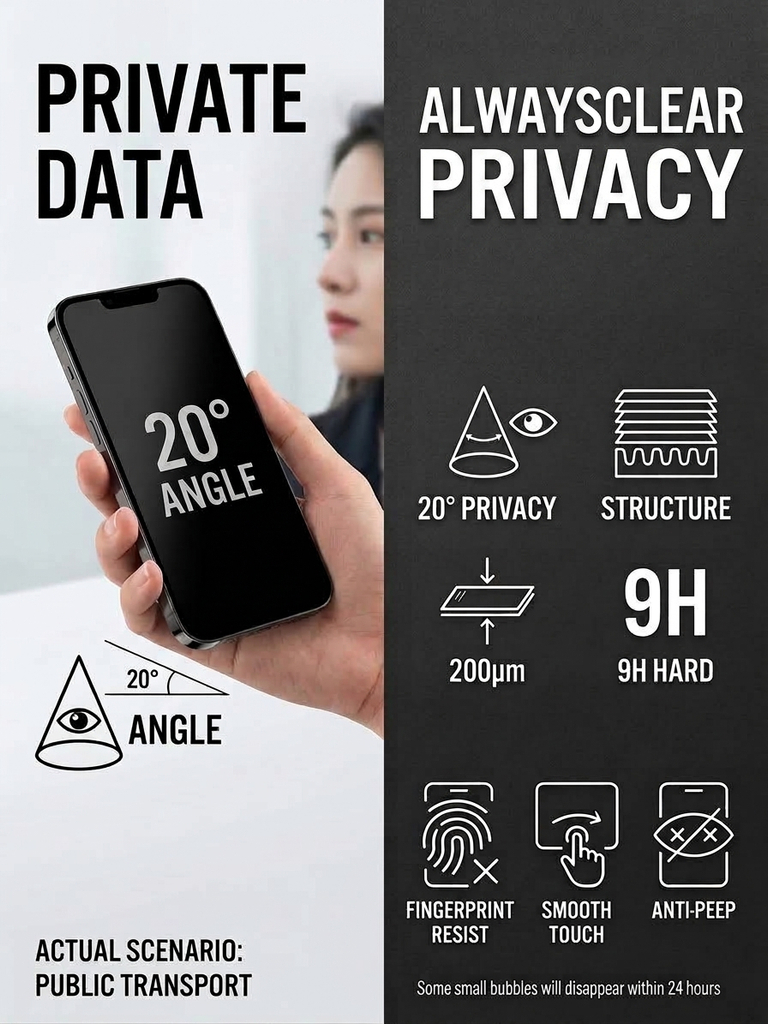
20 Ultra-Narrow Privacy Protection: Breaking past standard 30 or 45 limits, Yizhen achieves 20 ultra-narrow privacy protection. The screen darkens rapidly when the viewing angle shifts just 20 off-center.
High Clarity Front View: By pairing refined micro-structure embossing with high-transmittance optical substrates, Yizhen privacy films preserve native screen brightness and color saturation, solving the “screen dimming” problem common to traditional privacy films.
2. Versatile Multi-Material & All-Scenario Product Matrix
Yizhen continues to refine physical micro-structures while integrating advanced polymer material technologies into its privacy lineup:
9H Plexiglass Privacy Series: Combining 9H surface hardness with high toughness, this line features a 480 composite thickness and 2.5D rounded edges. It provides scratch resistance, impact buffer, a silky smooth touch feel, clear front viewing, and 20 privacy protection.
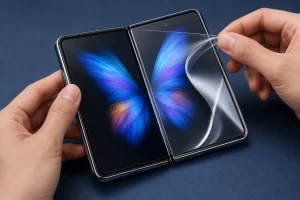
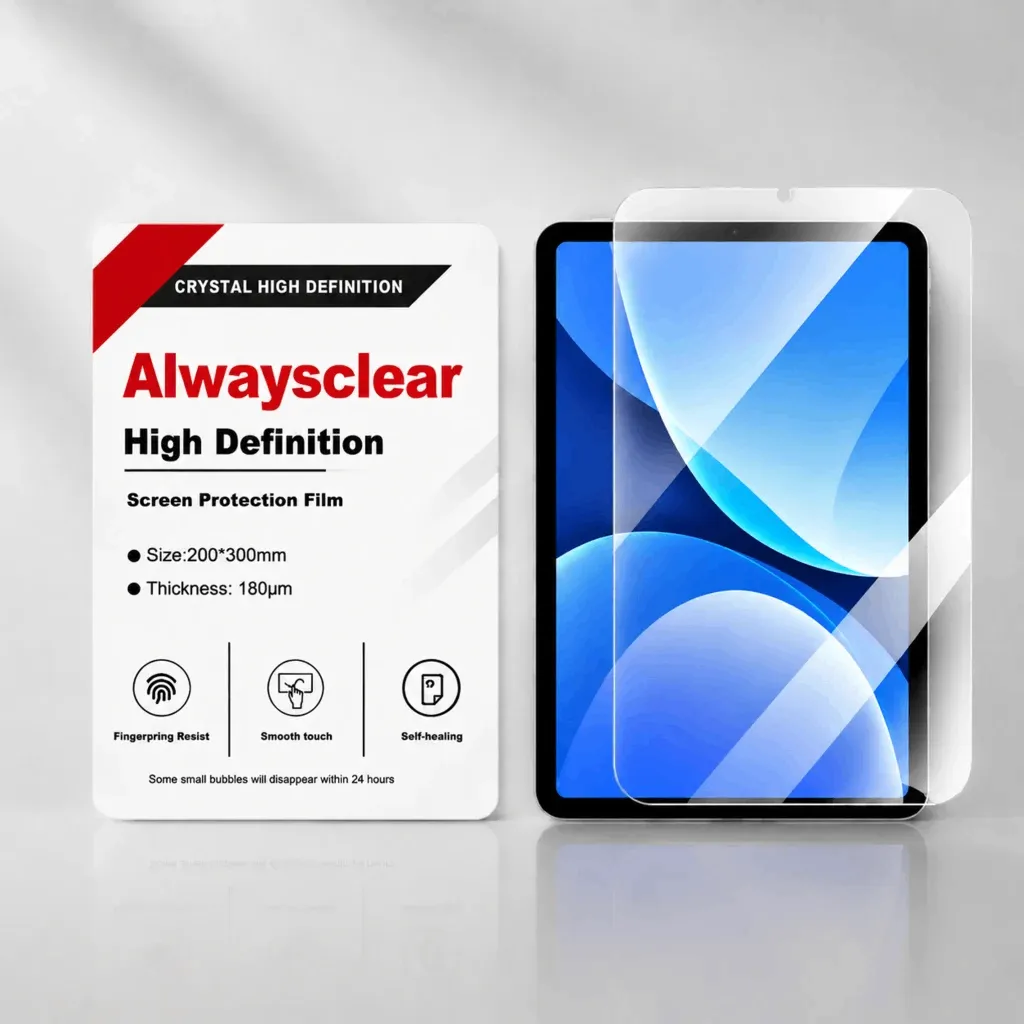
Alwaysclear Privacy Flexible Hydrogel/TPU Series: At just 200 thick, this series delivers both 20 privacy protection and anti-glare functionality. Its high elasticity allows 100% seamless edge wrapping on curved screens, paired with an oleophobic layer for ultra-sensitive touch response.
3. One-Stop Smart Film Cutting & Global OEM/ODM Services
As a capable privacy film factory, Yizhen provides high-quality film materials alongside automated film-cutting terminals and custom manufacturing services:
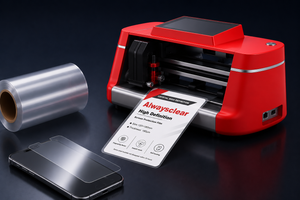
Autocut Pro & CS310 Smart Film Cutting Machines: Yizhen’s proprietary automated cutting machines (Autocut Pro / CS310) feature AI systems compatible with 9H Plexiglass Privacy, Alwaysclear Privacy, and hydrogel films. They support over 99% of phone, tablet, and laptop models, helping retailers achieve zero-inventory automated film cutting.
Professional Brand Customization (OEM/ODM): Yizhen provides full OEM/ODM and private label customization services. Certified under ISO 9001, ISO 14001, ISO 13485, and Global Recycled Standard (GRS), the company customizes sizes, thicknesses, logos, and packaging to ensure reliable mass production for global brands.
Through continuous technical innovation and high-yield manufacturing, Shenzhen Yizhen Technology Co., Ltd. (YIZHEN) continues to drive industry standards forward. Whether you are sourcing premium privacy films or automated film-cutting solutions, Yizhen provides dependable end-to-end support.