
Meta description: Engineering principles underlying screen protector blue light filter design. Optical mechanisms for high-energy visible light reduction, applicable test standards, and procurement-side verification methodology.
Optical Context: Display Emission and High-Energy Visible Light
Modern display panels, including LED-backlit LCD and OLED variants used across consumer smartphones, tablets, and laptops, produce broad-spectrum optical output spanning approximately 380 to 780 nanometres. Within this range, the 400 to 455 nanometre segment is classified as high-energy visible light, a designation formalised through the photobiological safety standards published by the International Commission on Non-Ionizing Radiation Protection.
The optical properties of this spectral band differ from those of longer-wavelength visible light in two material respects. First, shorter wavelengths are refracted more strongly by the ocular media, producing focal points marginally anterior to the retina under typical accommodation states. Second, photon energy in the 400 to 455 nanometre range is sufficient to drive photochemical reactions in retinal tissue, the cumulative effects of which have been studied in extended-exposure contexts by the American Academy of Ophthalmology and the European Society of Cataract and Refractive Surgeons.
Display manufacturers do not standardise high-energy visible light output across product categories. Panel-to-panel emission profiles vary by backlight technology, colour filter stack composition, and operating brightness. A film-based reduction layer applied at the display interface therefore operates against a variable spectral input, and product testing protocols must specify the measurement conditions under which reduction claims are validated.
Reduction Mechanisms at the Display Interface
Three principal mechanisms are documented in the technical literature for reducing high-energy visible light at the display interface. The mechanisms differ in optical physics, manufacturing complexity, and chromatic consequences, and selection between them is a design decision rather than a performance ranking.
Substrate-Level Wavelength Conversion
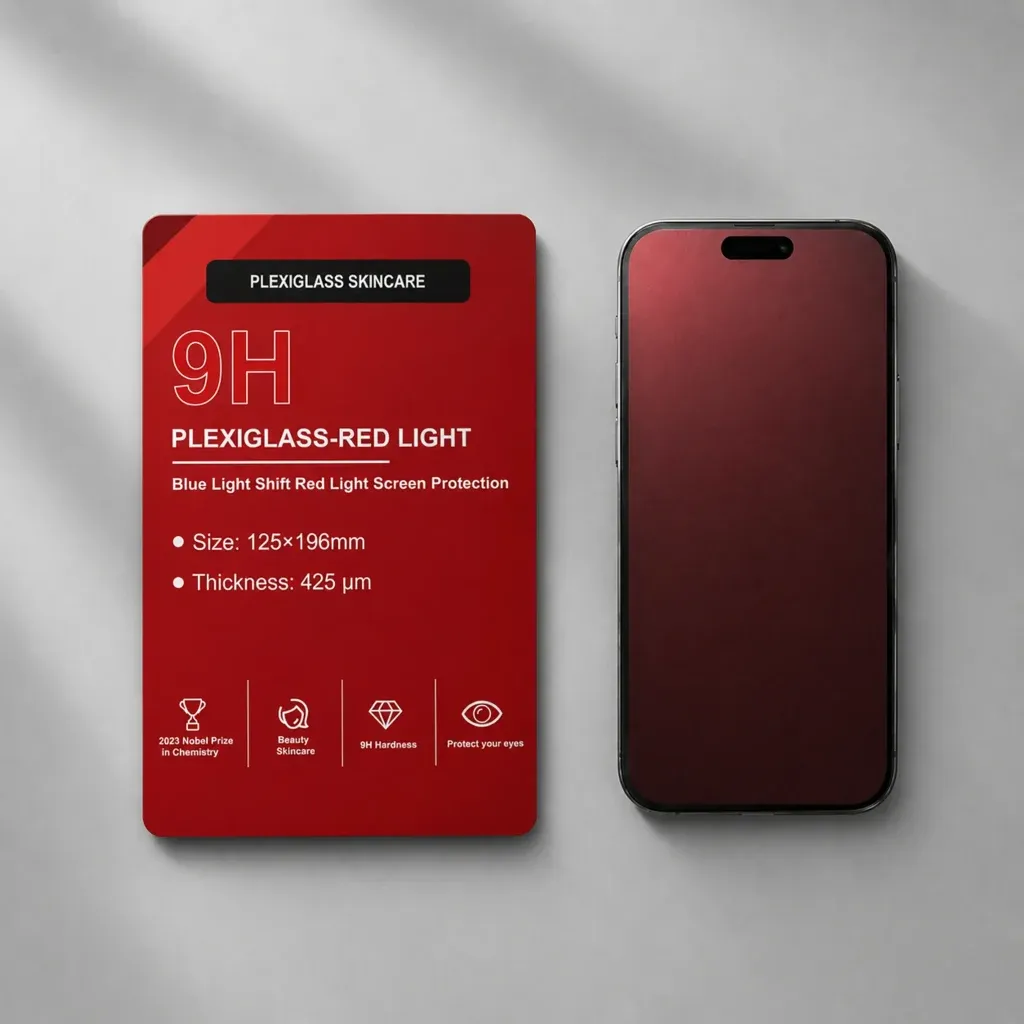
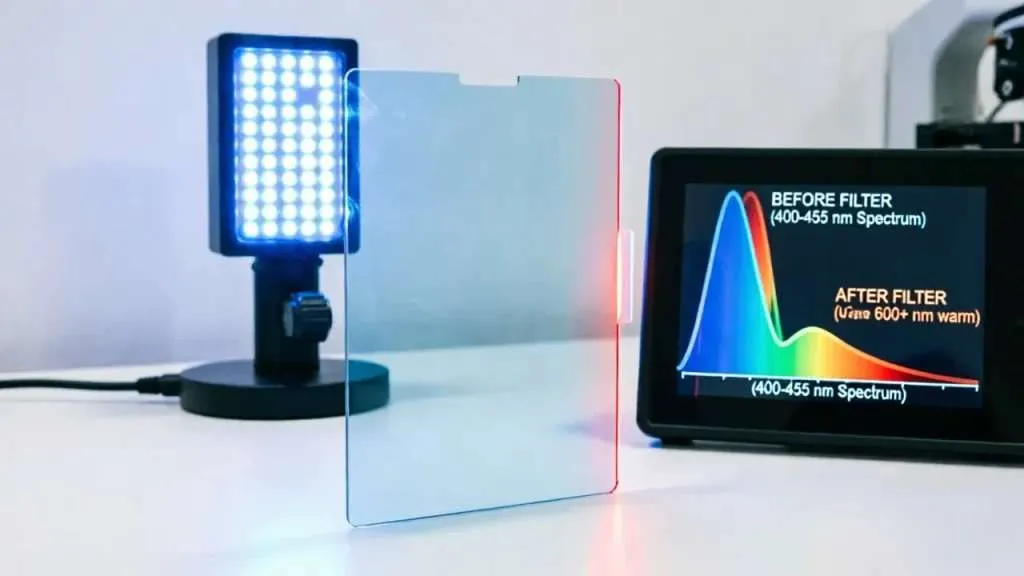
The first documented mechanism relies on modification of the polymer substrate itself, typically through incorporation of phosphorescent dopants into PMMA or TPU matrices. The mechanism is termed Stokes shift in the spectroscopy literature, after the physicist George Gabriel Stokes, who described the phenomenon in 1852: a material absorbs a photon at a higher energy (shorter wavelength) and emits a photon at a lower energy (longer wavelength). In the present application, the absorption-emission transition moves energy from the 400 to 455 nanometre band into the 600+ nanometre band, where the longer wavelength corresponds to lower photon energy and lower retinal penetration.
The chromatic consequences of substrate-level conversion depend on dopant concentration and substrate thickness. Verification requires spectrophotometric measurement under standardised illuminants, typically D65 per the CIE 1931 standard, with chromaticity coordinates reported as Delta E relative to an unmodified reference.
Surface-Applied Absorption Coatings
The second documented mechanism employs multi-layer coatings applied to the surface of an unmodified substrate. The optical principle is wavelength-selective absorption through thin-film interference, in which alternating layers of high-refractive-index and low-refractive-index materials produce constructive interference at target wavelengths, enhancing absorption at those wavelengths.
The chromatic consequences of absorption coatings depend on coating stack design. Coatings that target the 400 to 455 nanometre band exclusively preserve chromaticity at longer wavelengths, but practical coating stacks exhibit residual absorption into the 460 to 490 nanometre range, producing the perceptible yellow tint commonly observed in budget blue light filter products.
Hybrid Configurations
A third category combines substrate modification with surface coating, typically targeting residual high-energy visible light that escapes either single-mechanism approach. Hybrid configurations are documented in patent literature but are less common in commercial screen protector production due to compounding cost and verification complexity.
Applicable Test Standards
Three standards govern the measurement and reporting of optical performance in display interface films.
EN ISO 13696:2002 specifies spectrophotometric methodology for measuring luminous transmittance of transparent materials. The standard provides the measurement protocol for transmission curves across the visible spectrum and is referenced in third-party certification records for screen protector optical performance.
ASTM D3363-22 specifies the pencil hardness test method for film hardness assessment. While not an optical standard, it is the standard test method referenced in mechanical durability claims accompanying optical performance data in screen protector certification.
ASTM D1003-21 specifies the test method for haze and luminous transmittance of transparent plastics. The standard is referenced in transmittance and haze certification records for screen protector products.
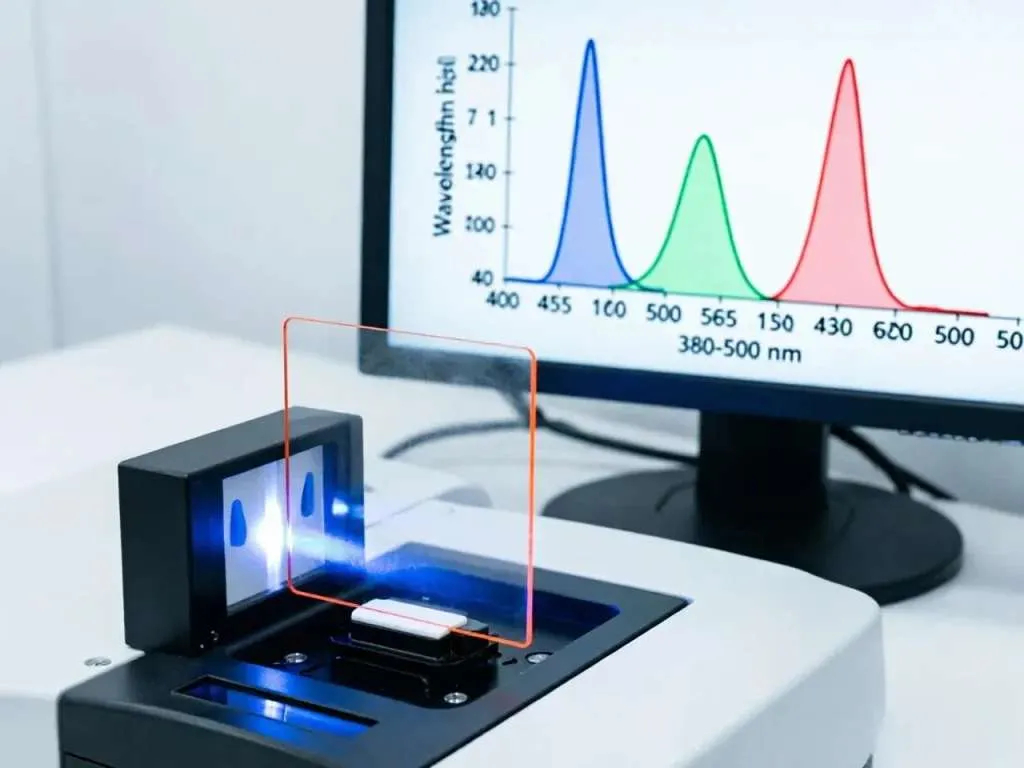
For high-energy visible light reduction claims specifically, the applicable reporting format is a continuous transmission curve across the 380 to 780 nanometre spectrum, with weighted reduction calculated for the 400 to 455 nanometre band. Single-value reduction claims lacking the underlying spectral curve do not permit independent verification.
Procurement Verification Protocol
Third-party certification records provide the basis for procurement-side verification of screen protector blue light filter products. Verification protocol should include the following checks.
Report number traceability. Certification records issued by TÜV Rheinland, SGS, Bureau Veritas, or Intertek carry unique report numbers traceable through the issuing body’s website. The TÜV Rheinland report CN269NNH 001, dated 2026-08-17, is an example of a verifiable certification record for screen protector optical performance. Certification records without a verifiable report number lack third-party verification status regardless of their visual presentation.
Spectral curve presence. A serious certification record includes a continuous transmission curve across the 380 to 780 nanometre spectrum, plotted at no greater than 5 nanometre intervals. Records presenting only a single numerical reduction value do not provide the spectral granularity required for procurement-side assessment.
Delta E reporting. Chromatic shift measurement under D65 illuminant per CIE 1931 should accompany HEV reduction data. Records reporting HEV reduction without chromaticity data do not permit assessment of the yellow tint side effect commonly associated with absorption coatings.
Multi-batch sample testing. Production consistency testing should be documented across at least three independent manufacturing batches. Records based on a single production run do not establish process stability at scale.
Cross-referenced certification. Procurement teams should verify that HEV reduction claims are cross-referenced with other certification records covering mechanical durability (ASTM D3363-22), transmittance and haze (ASTM D1003-21), and impact resistance, where applicable. Records lacking cross-referenced standards may indicate incomplete certification.
Procurement-Side Application
The selection of a reduction mechanism for a given procurement application depends on the chromatic tolerance of the target end-user population and the cost basis of the distribution channel.
Substrate-level wavelength conversion is technically applicable where chromatic preservation is required. The mechanism has documented academic literature and the underlying physics is reproducible through standard optical characterisation methods. Procurement teams evaluating substrate-level products should request Delta E measurements under D65 illuminant and verify the spectral transmission curve across the full 380 to 780 nanometre range.
Surface-applied absorption coatings are technically applicable where chromatic shift is acceptable to the end-user population. The mechanism is documented in thin-film optics literature. Procurement teams evaluating surface-applied products should request transmission curve data and verify that reported HEV reduction is consistent with the coating stack specification.
The verification protocol above applies to both mechanism categories and to hybrid configurations where present. Procurement decisions should be documented with reference to specific certification records and should distinguish between manufacturer-claimed performance and third-party-verified performance.