In the mobile phone screen protector industry, 9H Hardness has always been an important indicator that consumers and brands pay attention to.
High hardness usually means better scratch resistance, but an easily overlooked problem is:
Does high surface hardness necessarily mean stronger impact resistance?
The answer is not necessarily.
A screen protector may have high surface hardness, effectively resisting everyday scratches, but it may still crack or even break when subjected to a sudden impact.
Therefore, to evaluate a truly high-performance screen protection product, you cannot just look at the hardness, but also need to pay attention to Impact Resistance (impact resistance) and Fracture Toughness (fracture toughness).
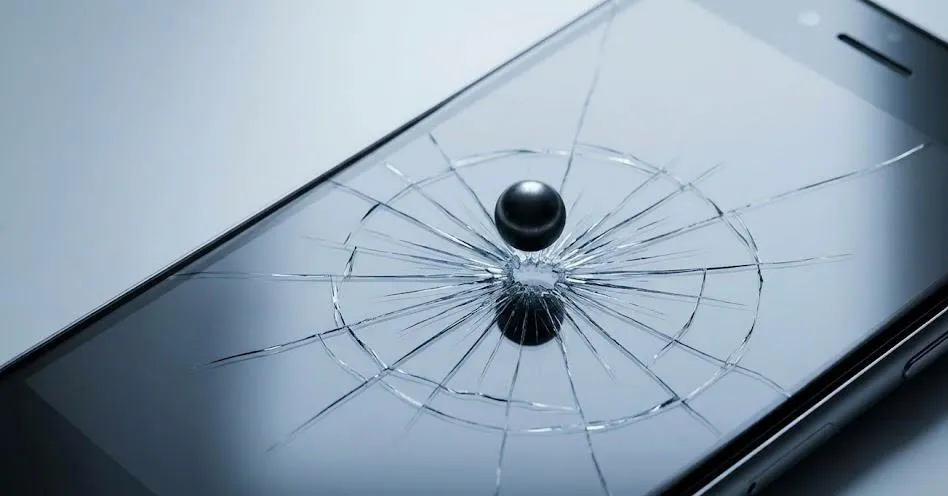
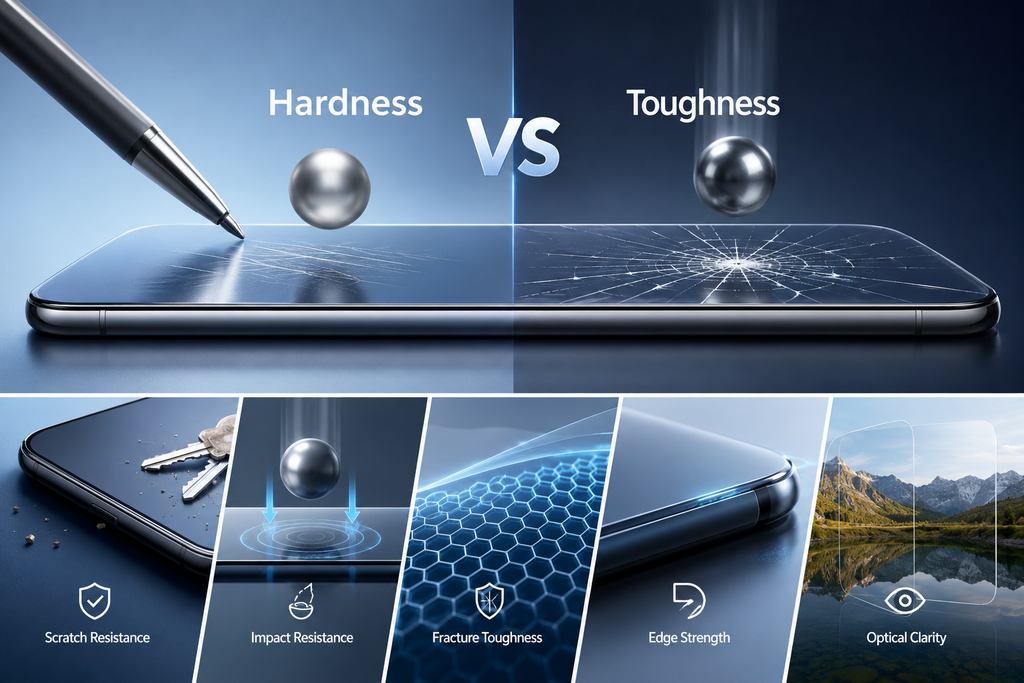
Surface Hardness:Why does the protective film need high hardness?
Surface hardness primarily reflects a material’s ability to resist surface scratches and deformation.
This is a critical property for screen protectors.
In daily use, mobile phone screens frequently come into contact with keys, coins, dust, and other hard objects. If the screen protector’s surface is not hard enough, it is easy for tiny scratches to appear, and over time, the screen surface will increasingly affect its appearance.
This is why you often see product advertisements like “9H Hardness” in the market.
Simply put: High surface hardness = better everyday scratch resistance.
However, the problem is that scratch resistance and impact resistance are not the same thing.
Why can’t “9H” represent full protection performance?
Imagine a ceramic mug. Its surface may be very hard and not easily scratched by ordinary objects. However, if you drop it from a certain height to the ground, it may still shatter.
The reason is simple:
Hardness and toughness are two different material properties. The same applies to protective films.
Pencil hardness tests primarily focus on the surface scratch resistance of materials, while a real phone drop will produce completely different stress conditions.
When a phone is suddenly dropped, the screen protector may experience a combination of forces:
- Instantaneous impact
- Local pressure
- Bending stress
- Edge stress
- Crack propagation
Therefore, even if a product has an excellent 9H hardness, its performance in a drop test cannot be judged solely based on this parameter.
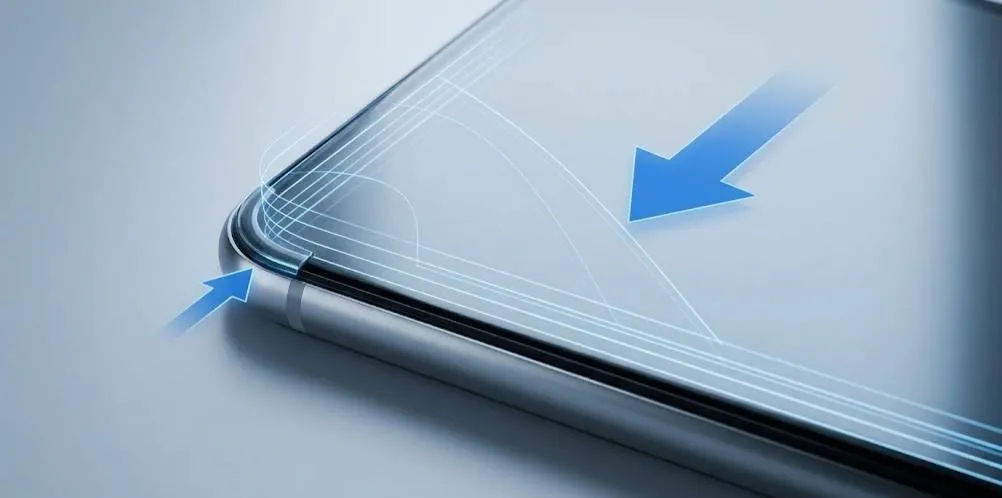
Fracture Toughness:Determines whether a material can resist crack propagation
If Surface Hardness primarily addresses “scratches,” then Fracture Toughness focuses on “cracks.”
Fracture toughness can be simply understood as: The ability of a material to resist crack initiation and prevent further crack propagation.
When the protective film is subjected to a strong impact, localized stress may be generated inside the material.
If the material is brittle, once a crack forms, it can quickly propagate to surrounding areas, eventually causing the protective film to rupture.
Materials with better toughness can more effectively absorb and disperse the energy generated by impact, thereby reducing the risk of rapid crack propagation.
Therefore, hardness determines its scratch resistance, while toughness affects its ability to remain intact when subjected to impact. This is why high-performance protective materials increasingly emphasize the combination of hardness and toughness.
Hardness vs Toughness:Both performance characteristics are equally important
Many consumers equate “hard” and “strong” with the same thing. In reality, they are not entirely the same.
| Capability | Main problems to be solved |
| Surface Hardness | Daily scratches and surface wear |
| Impact Resistance | Sudden fall, external impact |
| Fracture Toughness | Crack initiation and propagation |
| Edge Strength | Edge chipping and cracking |
| Optical Clarity | Long-term clear display |
A good screen protector should not just pursue a higher hardness rating.
The key is: Hard on the surface. Tough in structure. This design philosophy allows the protective film to reduce scratches during daily use, while providing more comprehensive protection in the event of accidental impacts.
What should consumers look for when choosing a screen protector?
Judging a product solely by the “9H” on its packaging makes it difficult for consumers to assess its true overall performance.
Surface durability: Can the protective film withstand long-term friction and daily use?
Impact resistance: When a phone is dropped, will the screen protector remain intact?
Fracture toughness: After a material is subjected to a localized impact, are cracks likely to continue to propagate?
Edge strength: Are the edges of the protective film prone to chipping and cracking?
Optical performance: Will it still maintain good transparency after long-term use?
Therefore, don’t just ask “Is it 9H?”, you should also ask “How does it perform in a real-world usage environment?”
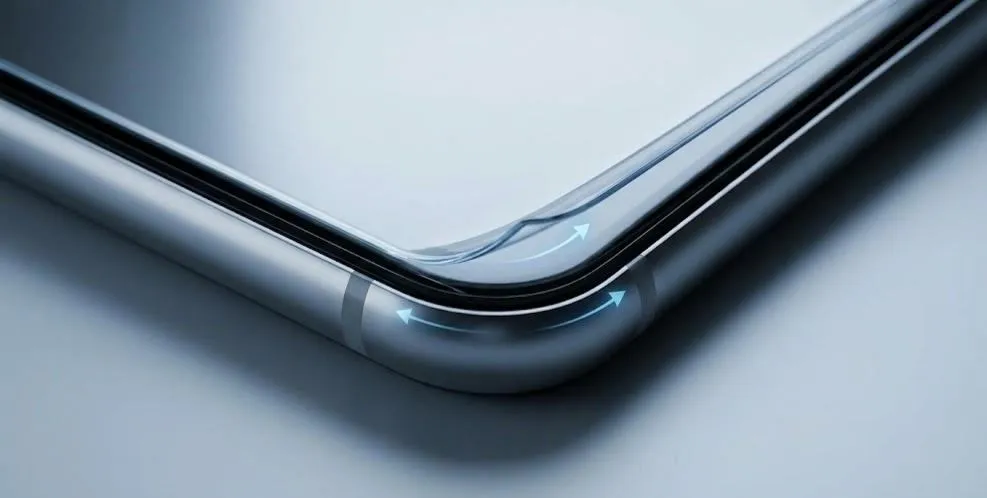
YIZHEN 9H Plexiglass:More than “9H”
Having understood the difference between hardness and toughness, let’s take a look at YIZHEN’s 9H Plexiglas.
YIZHEN does not use “9H” as the sole selling point of its products, but rather emphasizes the combination of high surface hardness and material toughness.
According to product information, YIZHEN 9H Plexiglass combines the hardness of glass with the toughness of composite materials, providing scratch resistance while emphasizing shatter resistance, and is optimized for edge chipping.
This means it focuses not only on:
“How hard is the surface?”
but also on:
“Can the overall structure remain stable when subjected to impact?”
9H Plexiglass:The combination of hardness and toughness
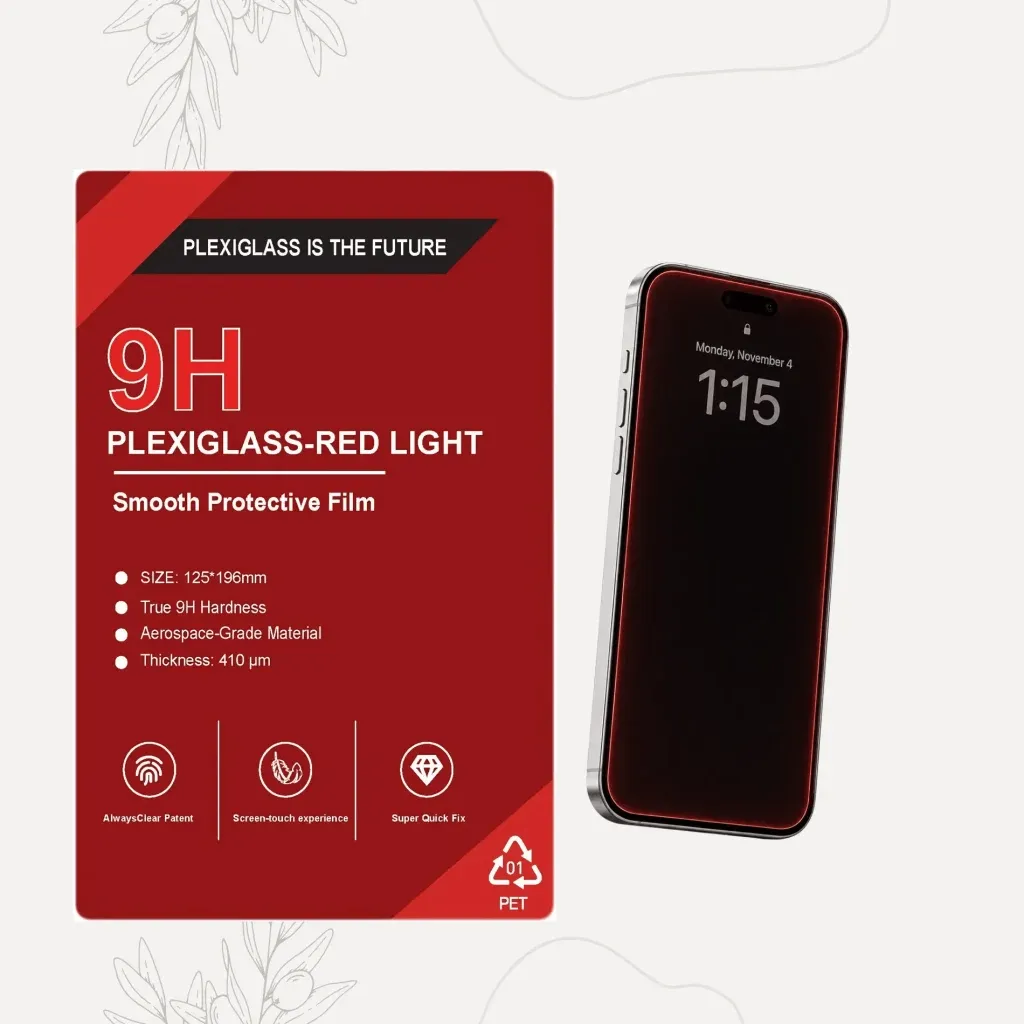
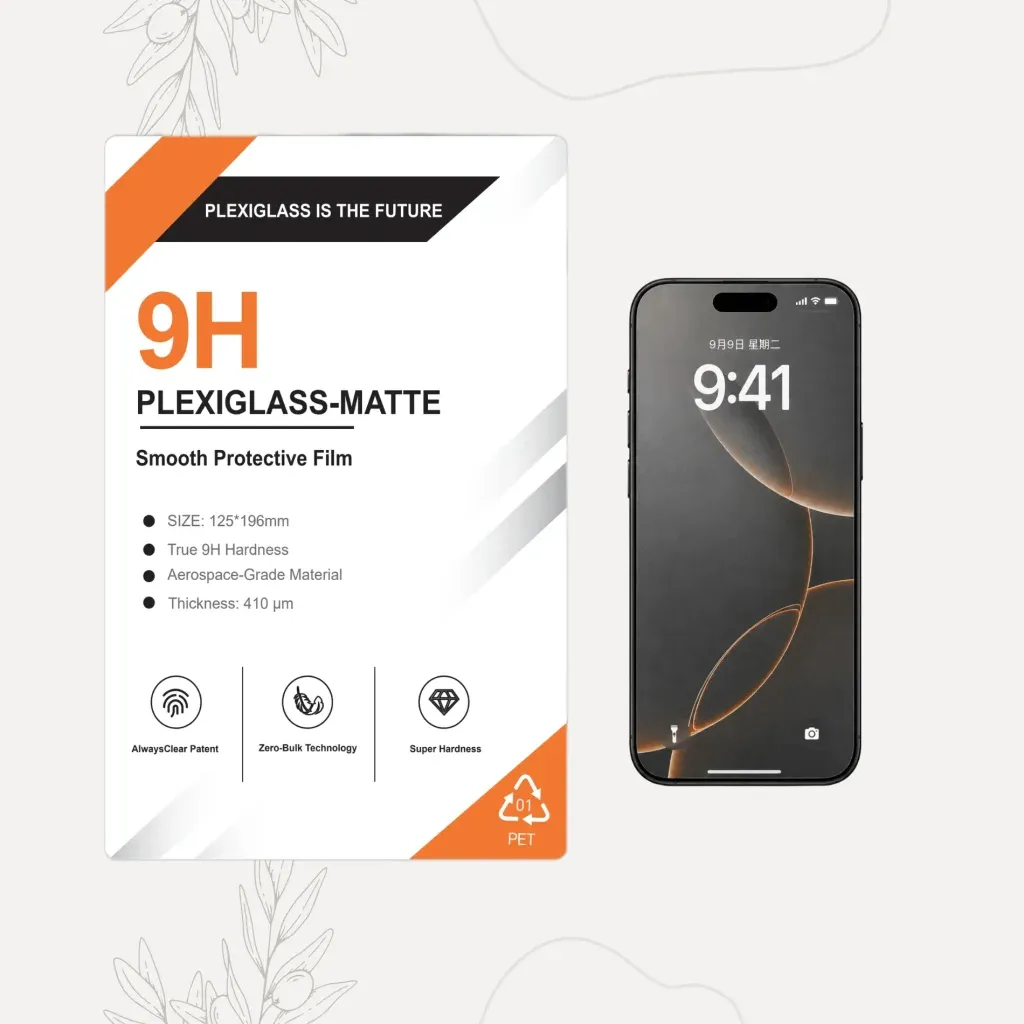
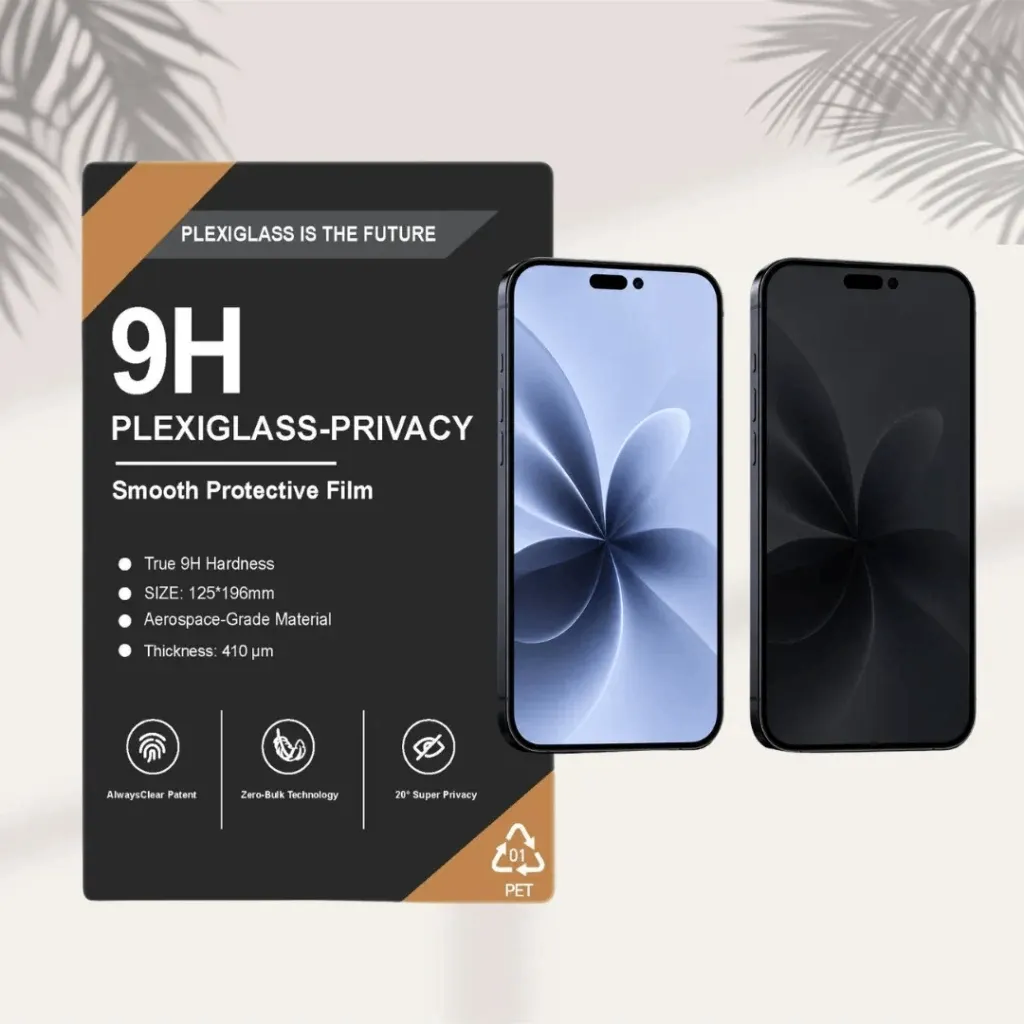
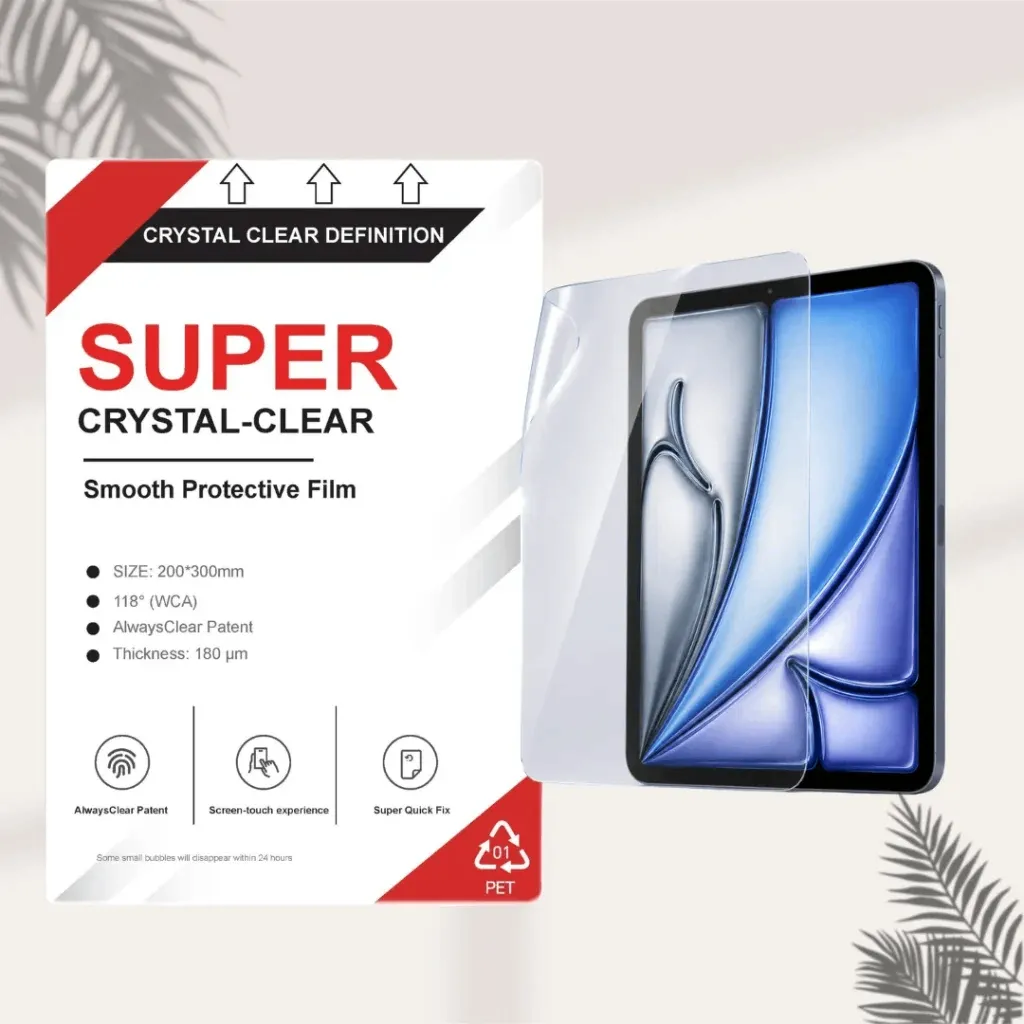
YIZHEN 9H Plexiglass currently offers a variety of product solutions, including:
High Definition
Privacy
Matte
Red Light
This allows for versatile product lineups tailored to different markets and customer needs.
The product adopts an enhanced multi-layer structure and a buffer core layer design.
The structure can maintain its integrity when subjected to high pressure and high-speed impact, thereby reducing the risk of dangerous fragments when traditional glass breaks.
Therefore, its product logic can be simply summarized as follows:
Scratch Resistance on the Surface.
Tougher Protection Inside.
We don’t just test hardness; we also focus on real-world performance
For high-end screen protectors, hardness testing alone is insufficient.
YIZHEN’s quality testing system covers:
Ball Drop Test
Friction Test
Light Transmittance Test
Hardness Testing
Product data shows that its quality verification includes:
- 32g / 100cm Ball Drop Test
- 3000+ Cycles Friction Test
- >95% Optical Transmittance
These tests verify the product’s impact resistance, surface durability, and optical performance.
This multi-dimensional testing approach helps brands and distributors gain a more comprehensive understanding of products, rather than relying solely on a single “9H” parameter.
Different devices require different materials
Not all mobile phones are suitable for hard protective materials.
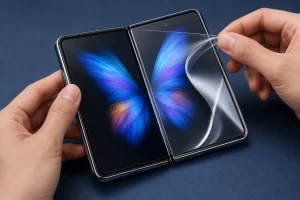
For users with curved screens, foldable screens, and those who pay more attention to the touch of bare screens, TPU flexible film may be a more suitable solution.
YIZHEN TPU Film emphasizes:
Bare-Screen Feel
Rapid Self-Healing
0.18 / 0.2/0.23mm
And stronger resistance to yellowing.
Therefore, a truly professional screen protection solution is not simply about choosing a single material.
It’s about:
Choose the Right Material for the Right Device.
From single products to complete B2B solutions
For overseas brand owners, wholesalers, and distributors, the product itself is only one part of the supply chain.
YIZHEN’s current product portfolio includes:
9H Plexiglas
Alwaysclear
TPU / EPU
Gehärtetes Glas
And various customized screen protection solutions.
Simultaneously supports:
- Size customization
- Thickness customization
- LOGO customization
- Material customization
- Package customization
- Private Label
According to YIZHEN’s data, the company has a production base of approximately 6,000 square meters with a daily production capacity of over 300,000 pcs, which can support the demand for large-volume orders from overseas markets.
For overseas customers, this means they can not only purchase a single product, but also build a complete screen protector product line based on their own market positioning.
The real question is no longer just “Is it 9H?”
In the past, consumers might have simply asked:
“Is it 9H?”
But now, for high-end screen protectors, that question is no longer sufficient。
More noteworthy is:
Is it scratch-resistant?
Is it impact-resistant?
How tough is its material?
Are the edges prone to chipping?
Will it remain clear after long-term use?These factors combined constitute the overall performance of a protective film.
Conclusion|9H is just the beginning, not the end
9H Hardness is important, but it’s not everything.
Surface Hardness determines the screen protector’s ability to resist scratches during daily use.
Fracture toughness affects a material’s ability to resist crack propagation when subjected to impact.。
Truly excellent screen protectors need to find a better balance between:
Hardness
Toughness
Impact Resistance
Edge Strength
Optical Properties
So next time you see a screen protector labeled “9H”, consider asking:
“After scratch resistance, how does it perform in terms of impact resistance?”
Because truly advanced protective materials shouldn’t just be:
Hard enough to resist scratches.
They should also be:
Tough enough to handle real-world impact.
YIZHEN 9H Plexiglass
Hard on the Surface. Tough in Structure.
Providing more comprehensive screen protection for real-world usage scenarios.